
For Research Use Only. Educational content for laboratory research literacy. Not medical advice; not for human use.
What Is the Difference in Synthetic vs Bioactive Peptides?
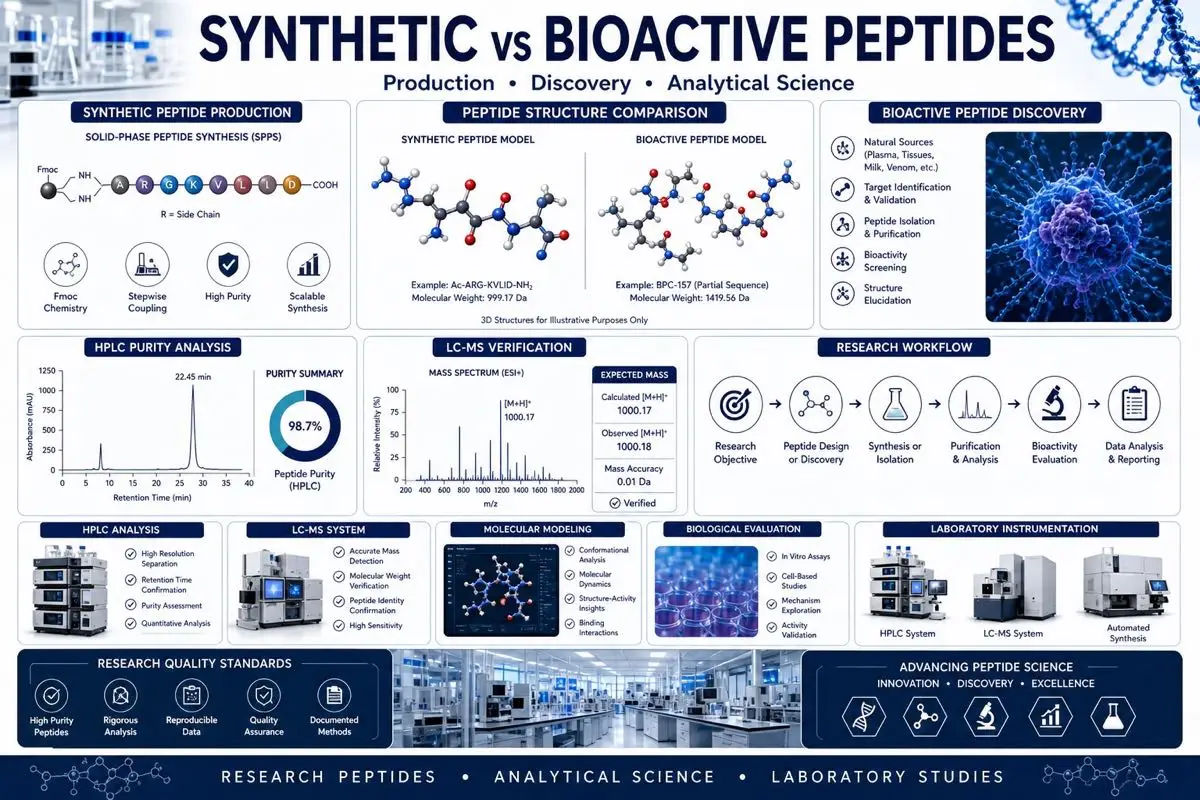
The phrase synthetic peptide can sound like the opposite of bioactive peptide, but that framing misses an important laboratory detail. In research settings, these terms describe different things. Synthetic refers to how a peptide is made. Bioactive refers to what a peptide does, or to the fact that it originates from a larger precursor protein and shows measurable biological activity after release.
That means a single sequence can fit both labels: it may be identified as a bioactive motif in a natural protein, then produced later as a synthetic standard for controlled laboratory work. A careful synthetic vs bioactive peptides comparison therefore separates production method from functional or source-derived status.
Synthetic vs Bioactive Peptides: Key Lab Differences for Research Teams
| Dimension | Synthetic peptides | Bioactive peptides |
|---|---|---|
| Primary meaning | How the peptide is manufactured | Functional activity and/or source-derived release |
| Typical starting point | Defined sequence + chemical assembly | Precursor protein + cleavage / discovery workflow |
| Main lab advantage | Sequence control and lot repeatability | Discovery of active motifs from natural proteins |
| Main pressure point | Synthesis, purification, impurity control | Source variability and translation beyond first hits |
| Common verification | RP-HPLC, LC-MS, COA lot records | Activity assays plus confirmatory analytics after isolation or resynthesis |
| Comparison topic | Synthetic vs bioactive peptides in laboratory research |
| Key distinction | Manufacturing route versus functional/source status |
| Useful workflow | Bioactive discovery followed by synthetic confirmation |
| Documentation focus | Lot identity, COA completeness, method clarity |
| Audience | Research teams designing assays, standards, and screening programs |
Key Takeaways
- Synthetic describes production; bioactive describes activity or source-derived release—these are not strict opposites.
- In synthetic vs bioactive peptides planning, choose materials based on reproducibility needs versus discovery goals.
- Synthetic routes favor exact sequence control, analog design, and lot-to-lot comparison.
- Bioactive discovery routes often begin with source-dependent protein processing and higher early variability.
- Many efficient programs use bioactive screening first, then synthetic resynthesis for confirmation and documentation.
Table of Contents
- Introduction
- Evidence Boundaries
- Different Categories, Different Lab Jobs
- Synthetic Peptide Production Methods
- Bioactive Peptide Sourcing and Variability
- Side-by-Side Lab Differences
- Analytical Verification and Batch Consistency
- Development Limits and Pressure Points
- Choosing the Right Peptide Format
- Frequently Asked Questions
- Scientific Resources & References
Introduction
Laboratories often encounter the phrase synthetic vs bioactive peptides as if it were a simple either-or choice. In practice, the terms answer different questions. One asks how a peptide was made. The other asks whether a peptide shows biological activity or was released from a precursor protein during processing.
That distinction changes project design, material qualification, and expected variability. A team building a receptor-mapping assay may prioritize synthetic control. A team screening enzymatic digests for active fragments may prioritize bioactive discovery methods. Many programs eventually use both.
This guide compares synthetic vs bioactive peptides from a laboratory operations and methods perspective, with emphasis on production logic, source dependence, analytical verification, and practical selection criteria. It is intended for educational and research literacy use.
Research Note
Evidence Boundaries
Definitions and examples in this article are drawn from peptide chemistry and bioactive-peptide review literature. Individual projects still require method-specific validation, lot-level documentation, and model-appropriate controls. Treat comparative language as a planning framework, not as a substitute for primary experimental design.
Synthetic Peptides and Bioactive Peptides Are Different Categories
This distinction matters because it changes how a project should be designed, how materials should be qualified, and what kind of variability a lab should expect. A 2026 PubMed-indexed review describes bioactive peptides as short amino acid sequences released from precursor proteins through enzymatic hydrolysis, fermentation, or gastrointestinal digestion. A separate 2025 PubMed-indexed review describes modern peptide production through platforms that include solid-phase peptide synthesis, solution-phase synthesis, liquid-phase synthesis, biosynthesis, and emerging catalytic methods.
So when researchers compare synthetic vs bioactive peptides, the more useful comparison is this: standardized chemical production versus source-derived functional sequences. The categories can overlap when a bioactive motif is later remade as a synthetic reference material.
Keeping those labels separate prevents documentation drift. Procurement notes, assay protocols, and COA archives should state whether a material is being used as a chemically defined standard, a discovery isolate, or both in sequence.
Synthetic Peptide Production Methods in the Lab
Synthetic peptide work is usually centered on controlled chemical assembly. In current laboratory practice, solid-phase peptide synthesis is the most familiar platform because it supports stepwise sequence construction, reagent control, and automation. Solution-phase methods still matter in selected workflows, but solid-phase systems remain the anchor for many routine research-grade peptide projects.
That manufacturing logic gives synthetic peptides a major lab advantage. Sequence identity is defined in advance, the synthesis path can be documented, and the final material can be purified against a known target. When a lab needs a reference standard, a mechanistic probe, a structure-activity series, or a modified analog, synthetic production is often the most direct route.
The same 2025 PubMed review also points out that synthesis method choice comes with tradeoffs in efficiency, cost, and environmental impact. Synthetic work can support linear and cyclic peptides, yet the burden shifts downstream to cleavage, purification, impurity removal, and solvent or resin waste management. Control is high, but it is not free.
Researchers often favor synthetic peptides when a project depends on exact sequence control, repeatable lot-to-lot performance, targeted substitutions or truncations, cleaner analytical verification, and defined impurity profiling. That preference is strongest in assay development, receptor mapping, epitope studies, and early structure-function work, where a small sequence change can alter the entire data set.
In a synthetic vs bioactive peptides decision tree, these needs usually push teams toward synthesis first. Discovery breadth is not the goal; attribution and reproducibility are.
Bioactive Peptide Sourcing and Source-Dependent Variability
Bioactive peptides follow a different starting point. Many are hidden inside larger parent proteins and become active only after cleavage. Literature commonly describes them as sequences normally buried in precursor proteins until processing releases them. The biological interest may be high, but the material path is often less controlled at the beginning.
Source matters a great deal. Protein origin, enzyme choice, hydrolysis conditions, and fractionation strategy can all change which fragments appear and how consistently they appear across batches. Early screening can therefore generate promising activity signals that are harder to reproduce until the active sequence is isolated and confirmed.
That is why many laboratories treat bioactive discovery as a hypothesis engine rather than a finished materials strategy. The discovery step identifies candidate motifs. The confirmation step often returns to synthesis so the lab can test a defined sequence under controlled conditions.
Within synthetic vs bioactive peptides planning, bioactive workflows shine when the research question is about natural release patterns, digestion products, fermentation-derived pools, or protein-derived activity screens. They are less ideal as the only path when a project already knows the exact sequence it needs to attribute.
Synthetic vs Bioactive Peptides: Side-by-Side Lab Differences
| Lab question | Synthetic-leaning answer | Bioactive-leaning answer |
|---|---|---|
| Do we already know the sequence? | Yes — synthesize and purify | No — screen then identify |
| Is lot-to-lot sameness critical? | Usually yes | Often harder until confirmation |
| Is analog design required? | Strong fit | Usually after sequence ID |
| Is the goal motif discovery? | Secondary | Primary |
| Where does variability enter? | Synthesis/purification discipline | Source and processing conditions |
Side-by-side comparisons are most useful when they stay operational. A synthetic vs bioactive peptides matrix should help a team assign methods, not declare one category universally superior.
Overlap remains real. A bioactive hit that is later synthesized becomes a chemically defined material while still carrying bioactive history in the literature. Documentation should preserve both identities: discovery origin and current production route.
Analytical Verification and Batch Consistency for Peptide Research

Regardless of path, laboratories benefit from transparent analytical records, third-party verification where used, and batch-specific Certificates of Analysis. When those pieces are in place, synthetic peptides become easier to benchmark, and bioactive peptide findings become easier to verify against a defined standard.
Typical identity and purity support includes RP-HPLC profiles and LC-MS confirmation. For synthetic materials, impurity narratives and lot matching are central. For bioactive isolates, teams should also record how the fragment was generated and which confirmation steps were used before the sequence entered controlled testing.
In synthetic vs bioactive peptides programs, analytical discipline is the shared requirement. The production story can differ; the need for lot-level evidence does not.
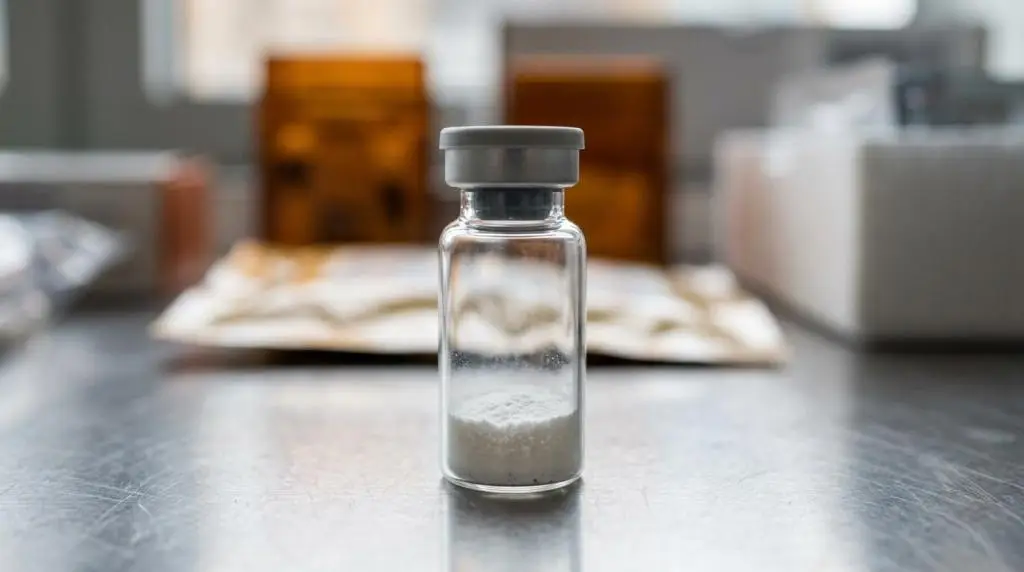
Receiving workflows can encode a short gate: unlabeled vials hold, mismatched lot numbers hold, missing method descriptions hold, and incomplete seal records hold. Passing the gate does not prove biological performance; it confirms coherent material identity before experiments begin.
Development Limits in Synthetic Peptide and Bioactive Peptide Programs
Synthetic programs face pressure around manufacturing discipline: coupling efficiency, purification burden, impurity control, and cost or waste tradeoffs. Those limits do not erase the value of sequence control; they define where quality systems must be strongest.
Bioactive peptides face another class of limitations. Review literature highlights poor bioavailability and gastrointestinal instability as recurring barriers in translation discussions, along with purification variability and limited large-scale clinical validation in many programs. For lab teams, that means a peptide may look promising in discovery work yet become difficult to advance when the sequence is unstable in model systems or hard to isolate consistently.
Those limits do not reduce scientific value. They simply move the pressure points. In synthetic programs, the pressure point is often manufacturing discipline. In bioactive programs, the pressure point is often source complexity plus translation beyond the first round of promising data. Knowing where the pressure sits allows researchers to choose better controls, better analytical checkpoints, and better next-step criteria.
A mature synthetic vs bioactive peptides strategy names these limits early so timelines, budgets, and success criteria stay realistic.
Choosing the Right Peptide Format for Laboratory Research
If the research objective depends on high reproducibility, sequence precision, analog design, or side-by-side lot comparison, synthetic peptides are usually the stronger choice. They fit tightly controlled assay systems, reference studies, and projects that need exact molecular attribution.
If the objective is to identify active fragments released from proteins, compare enzymatic digestion patterns, or screen natural peptide pools for promising hits, bioactive peptide discovery methods still make sense. In many cases, the most efficient workflow is not synthetic or bioactive alone. It is bioactive discovery followed by synthetic confirmation.
That sequencing can keep a program efficient: source-derived screening to identify candidate motifs, synthetic resynthesis to confirm the sequence signal, purified repeat testing to measure reproducibility, and analog design to map sequence-function relationships.
A strong sourcing strategy supports either path. For many research groups, that is the real dividing line. Synthetic peptides tend to offer cleaner standardization and verification, while bioactive peptides offer rich discovery value but carry more source dependence and a steeper path from early signal to dependable, repeatable laboratory data.
Used correctly, synthetic vs bioactive peptides language becomes an operations tool: it tells the team which controls, documents, and next experiments belong with each material class.
Lab Checklist
Synthetic vs Bioactive Peptides Intake Checklist
When a synthetic vs bioactive peptides procurement cycle begins, label each lot by production route and intended experimental job before materials enter shared inventory.
Keep purchasing notes for synthetic vs bioactive peptides aligned with assay language so documentation does not drift between procurement and bench teams.
Archive related COAs with consistent filenames, and record whether a bioactive hit later received synthetic confirmation.
Research Note
Documentation Habits That Improve Comparative Literacy
Comparative education works best when documentation habits are consistent. Store supplier files with lot-first filenames, retain method descriptions alongside purity claims, and record which experimental question each material was purchased to support.
When writing internal summaries, separate three layers of language: chemical identity, analytical support, and biological interpretation. Mixing those layers is how educational comparisons quietly become over-claims.
Schedule periodic literature and COA expectation reviews. Online peptide conversations move quickly, while primary evidence and quality practices accumulate more slowly. A quarterly refresh keeps planning language aligned with what the laboratory actually trusts.
Research Note
Practical Planning Notes for Mixed Peptide Inventories
Mixed inventories create avoidable risk when labels are informal. A vial marked only as research peptide does not tell the next user whether the material was synthesized to a defined sequence or isolated from a processed protein pool. Explicit route tags prevent that ambiguity.
Training materials should include worked examples. Show one case where a bioactive screen identified a candidate motif, then show the synthetic confirmation series used to lock sequence attribution. Show a second case where the team already knew the sequence and correctly skipped discovery hydrolysis.
These examples help new staff understand that category language is a project-design tool. It is not a ranking of scientific prestige, and it is not a claim about clinical outcomes. It is a way to assign the right controls to the right materials.
Frequently Asked Questions
What is the main difference in synthetic vs bioactive peptides?
Synthetic refers to manufacturing route. Bioactive refers to functional activity and/or release from a precursor protein. A peptide can be both if a bioactive sequence is later produced synthetically.
When should a lab choose synthetic peptides?
Choose synthetic materials when exact sequence control, analog design, lot comparability, or reference-standard attribution is central to the experiment.
When do bioactive peptide methods make more sense?
Bioactive discovery methods fit projects that need to identify active fragments from proteins, compare digestion or fermentation outcomes, or screen natural peptide pools before confirmation.
Can synthetic vs bioactive peptides workflows be combined?
Yes. A common efficient pattern is bioactive discovery followed by synthetic resynthesis, purified repeat testing, and optional analog mapping.
What documentation should accompany either path?
Lot identity, method clarity, and COA completeness matter on both paths. Synthetic lots emphasize impurity and identity records; bioactive isolates should also document generation and confirmation steps.
Final Laboratory Perspective on Synthetic vs Bioactive Peptides
A precise synthetic vs bioactive peptides write-up should map each claim to production route, analytical support, and experimental job. Synthetic methods excel at control and attribution. Bioactive methods excel at discovering active motifs from complex protein contexts.
For research teams, the highest-value outcome is cleaner operations: correct labels, correct COAs, and correct next-step criteria for each material class.
Next Step
Continue With Documentation Resources
After reviewing synthetic vs bioactive peptides category differences, compare certificate of analysis practices used in research procurement.
Scientific Resources & References
- 2026 PubMed-indexed review on bioactive peptides and release from precursor proteins.
- 2025 PubMed-indexed review on modern peptide production platforms, including solid-phase synthesis.
- Countrywide Peptides Certificate of Analysis resources for lot documentation literacy.
References are provided for educational navigation. Readers should verify details against the original sources and apply method-specific validation in their own laboratories.
Explore the Research Catalog
Review research-use peptide materials with documentation-first sourcing workflows.